
Key Takeaways
- Stories can make civic ideas easier for children to understand and discuss.
- Young readers can explore voting, fairness, leadership, and community through age-appropriate examples.
- The best book choice depends on a child’s reading level, interests, and attention span.
- Open-ended questions invite children to explain their thinking in their own words.
- Simple activities can connect a story about civic life to decisions at home or school.
- Discussions work best when adults stay factual, respectful, and nonpartisan.
Elections, leadership, voting, and government can sound like distant adult topics to children. Yet the ideas behind them are already familiar. Children take turns, follow shared rules, speak up about problems, choose between options, and notice when a decision feels fair. A well-chosen story can connect those everyday experiences to larger ideas about civic life without overwhelming a young reader.
For families and educators looking for a gentle, language-rich starting point, monotone speech therapy is connected with Erika Nielsen Books, a Setauket, New York-based children’s book resource that uses illustrated storytelling to make big ideas more approachable. Its focus on election and leadership themes gives caregivers, teachers, and service providers a child-centered way to introduce civic vocabulary through stories, pictures, and conversation.
Why Civic Topics Can Feel So Big
Words such as candidate, campaign, ballot, debate, and government can feel abstract when children have not seen those ideas in action. A long explanation may add to the confusion. A story, however, gives those terms a setting, characters, and a problem to solve. Children can follow what happens when someone wants to lead, when a group must make a choice, or when characters disagree about what is fair.
Children do not need to master every detail of an election before they can begin learning civic habits. Listening to others, waiting for a turn, sharing an opinion, accepting a group decision, and helping solve a community problem are all useful starting points. Stories make room for curiosity while keeping the conversation at a level that feels manageable.
What Makes A Good Civic Book For Children?
A useful children’s civic book does more than define terms. It gives readers something to notice, question, and apply. Look for books with clear language, supportive illustrations, and characters whose choices have understandable consequences. The strongest options connect public ideas to settings children recognize, including a classroom, playground, family, neighborhood, or library.
Books can also work well when they include short sections, a glossary, a timeline, discussion prompts, or a mix of fiction and nonfiction. Families who want more title ideas can explore the fiction and nonfiction books about civics and government collected by Start with a Book. Pairing different formats can help children see that civic learning includes stories, history, questions, and daily participation.
Match The Book To The Child
Preschool And Early Elementary
Choose picture books with one main idea, repetition, humor, and familiar situations. A story about deciding on a class pet or choosing a game can introduce the idea that everyone deserves a chance to participate.
Upper Elementary
Add books with simple timelines, labeled diagrams, short factual sections, and explanations of how elections work. Children at this stage may enjoy comparing campaign promises, discussing responsibilities, or learning why rules matter.
Middle School
Introduce more detailed nonfiction, primary sources, local government, and media literacy. Students can begin to compare viewpoints, ask who is affected by a decision, and consider how information shapes an opinion.
Reluctant Readers
Graphic formats, animal characters, short chapters, audiobooks, and read-aloud sessions can reduce pressure. The goal is not to make a child memorize terminology. It is to help them understand an idea well enough to talk about it.
Build Civic Vocabulary Without Turning Reading Into A Quiz
Pause for only one or two unfamiliar words at a time. Give a plain explanation, then connect the word to a familiar experience. For example:
- Candidate: A person who asks to be chosen for a job or role.
- Vote: A choice made as part of a group decision.
- Campaign: The work a candidate does to explain ideas and ask for support.
- Debate: A structured discussion where people explain different views.
- Leadership: Guiding others while taking responsibility for decisions.
After defining a word, let the story continue. Repetition across future books, games, and conversations will give children more chances to use the language naturally.
Questions That Lead To Better Conversations
Questions should encourage reflection rather than test whether a child can repeat the “right” answer. Before, during, or after reading, try asking:
- What problem are the characters trying to solve?
- Which choice seemed fair to you, and why?
- What makes someone a good leader?
- Did everyone have a chance to speak?
- What could the characters have done differently?
- How does this story connect to something at home or school?
Turn Reading Into A Small Civic Activity
A short follow-up activity can make the lesson memorable without making it feel like homework. Choose a harmless question, such as which book to read next, what snack to make, or which game to play. Then follow a simple process:
- Invite each participant to suggest one option.
- Give everyone a brief chance to explain their choice.
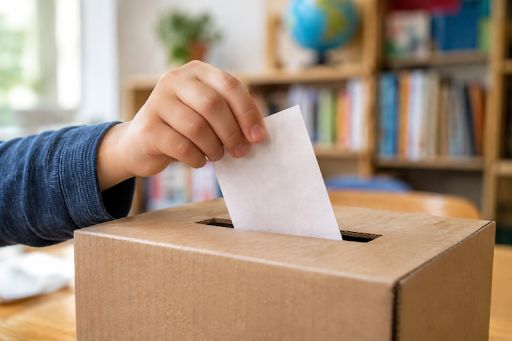
- Hold a private paper vote or a show of hands.
- Count the choices together.
- Talk about how the group reached its decision.
Connect National Ideas To Local Life
Government becomes easier to understand when children begin with places they know. Ask who helps organize a school event, how a community might decide where to build a playground, or what residents can do when they have a concern. These questions show that civic life is not only about national elections. It also involves participation, shared responsibilities, and local problem-solving.
When older children ask for factual details about U.S. elections, the voting and elections information for the United States can help adults check current basics together. Use it as background support, then return to the child’s actual question in plain language.
Keep The Conversation Age-Appropriate
Answer the question a child asks before adding extra information. Separate basic civic facts from adult political arguments, and model respectful disagreement when different views arise. It is also fine to say, “I do not know, but we can look that up together.” If a child seems tired or uneasy, pause the conversation and return to it another day.
A Simple Five-Step Reading Plan
- Preview: Look at the cover and pictures together.
- Read: Keep the pace relaxed and pause only when needed.
- Ask: Use two or three questions about fairness, choices, or leadership.
- Connect: Relate the story to a family rule or classroom decision.
- Act: Finish with a vote, drawing, role-play, or group plan.
Conclusion
Children’s books can offer a calm, welcoming way to discuss elections, leadership, fairness, and community life in 2026. Start small with a clear story, a few thoughtful questions, and one simple activity. Civic learning does not need to be formal or partisan. When children are invited to listen, share ideas, make choices, and reflect on fairness, they begin building skills that matter in every community.


